
The e-Delivery platform provided two distinctly different user experiences. Subscribers using the desktop version interacted with a legacy interface that relied on floating menus, keyboard shortcuts, and desktop-specific navigation, while users on the mobile and tablet apps experienced an entirely different interface and workflow.
This inconsistency created unnecessary friction for subscribers who moved between devices. Features were located in different places, navigation patterns varied, and the overall experience lacked continuity across platforms.
As Director of Digital Product & Platform Strategy, I identified an opportunity to modernize the desktop experience while bringing it into alignment with the mobile and tablet applications. The goal was not simply to redesign the interface — it was to create a single, cohesive e-Delivery experience regardless of how subscribers accessed the product.

Key Challenges
Desktop experience differed significantly from the mobile and tablet apps.
Inconsistent navigation and interaction patterns across platforms.
Legacy desktop interface relied on outdated UI conventions.
Users had to relearn workflows when switching devices.
Limited consistency made future enhancements more difficult.
Need to modernize while maintaining familiarity for long-time subscribers.
The redesign began with a comprehensive discovery phase focused on understanding how subscribers interacted with the e-Delivery platform across desktop, tablet, and mobile. Rather than treating the initiative as a visual redesign, I evaluated the complete reader experience to identify inconsistencies, workflow friction, and opportunities for modernization.
Working closely with newsroom stakeholders, engineering teams, customer support, and platform vendors, I documented the existing experience, reviewed feature parity across platforms, and identified where navigation patterns and user expectations diverged.

The discovery process revealed several key opportunities:
Different experiences between desktop and mobile applications
Navigation patterns that varied across platforms
Legacy desktop workflows that no longer reflected modern usability standards
Features that were difficult for readers to discover
A need for a scalable information architecture that could support future enhancements
These findings became the foundation for the product vision and roadmap, ensuring the redesign solved underlying user experience problems rather than simply refreshing the interface.
The vision for the redesigned e-Delivery platform extended beyond a visual refresh. The objective was to create a consistent digital newspaper experience across desktop, tablet, and mobile while simplifying navigation and providing a scalable foundation for future enhancements.
Working closely with newsroom stakeholders, engineering teams, and platform vendors, I defined the product requirements for a unified experience that prioritized usability, discoverability, and long-term maintainability.
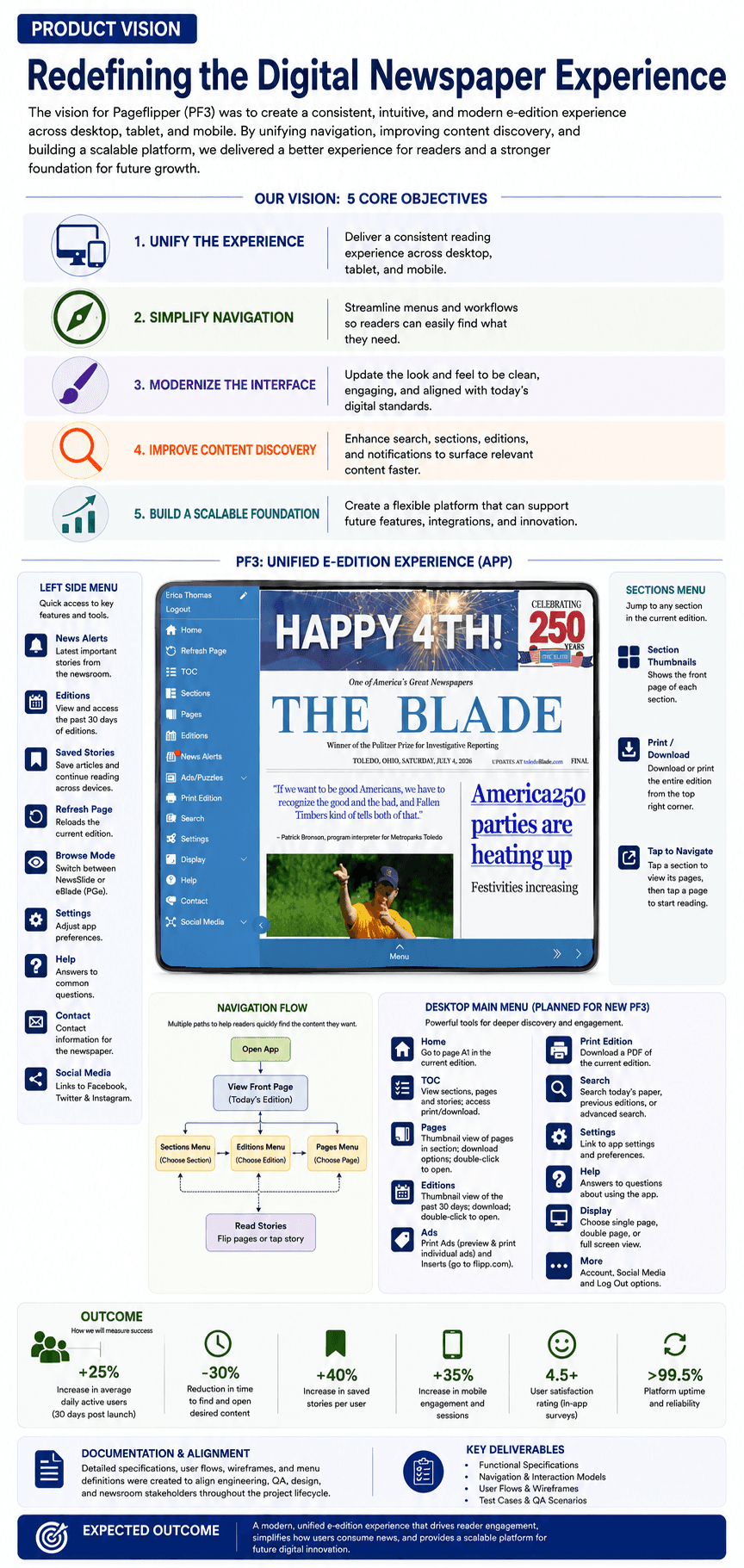
The product strategy focused on five core objectives:
Unify the reading experience across desktop, tablet, and mobile
Simplify navigation through a consistent information architecture
Modernize the interface while preserving familiar newspaper workflows
Improve content discovery through enhanced search, menus, and navigation
Build a scalable platform that could support future digital features
The result was a product vision that balanced customer expectations with technical feasibility while creating a roadmap for continuous platform evolution.
A successful redesign of the e-Delivery platform required more than great design—it required careful planning across multiple product releases, engineering teams, and newsroom stakeholders.
Working with engineering, QA, editorial leadership, and platform vendors, I developed a phased product roadmap that balanced user impact, technical complexity, and business priorities. Rather than attempting a single large release, we prioritized foundational improvements first, followed by iterative enhancements and platform rollout.
The roadmap provided a shared view of project milestones, release timing, dependencies, and stakeholder expectations throughout development. It also allowed the team to adapt when feedback from QA and User Acceptance Testing (UAT) identified additional refinements before launch.
The phased delivery approach resulted in a successful desktop release in November 2021, followed by a unified mobile and tablet experience in November 2022, while minimizing disruption for subscribers and newsroom operations.

Key Roadmap Highlights
Defined phased releases based on customer value and technical dependencies.
Coordinated engineering, QA, editorial, and vendor deliverables.
Incorporated stakeholder feedback throughout development.
Extended testing after QA and UAT uncovered usability improvements before release.
Delivered desktop and mobile experiences through separate production launches to reduce deployment risk.
To align engineering, QA, editorial, and platform stakeholders around a shared product vision, I created comprehensive product documentation that defined navigation flows, feature requirements, interaction models, acceptance criteria, and implementation guidance for every major component of the redesigned platform.
These artifacts served as the single source of truth throughout development, enabling consistent implementation across desktop, tablet, and mobile while streamlining QA, stakeholder reviews, and production readiness.
The documentation established a common framework for decision-making, reducing ambiguity during development while ensuring the final product remained aligned with the original product vision.

See the Requirements Behind the Product

Software Requirements Specification
35 pages · 16 versions
I created and maintained the detailed Software Requirements Specification for the e-Delivery platform, documenting functional requirements, user workflows, interface behavior, business rules, and implementation details used by the development team.
The e-Delivery modernization established a unified digital newspaper experience across desktop, tablet, and mobile while creating a scalable platform for future innovation. Rather than simply refreshing the interface, the initiative standardized navigation, improved content discovery, and aligned the product experience across every device.
The redesigned platform became the foundation for continued digital growth, enabling new capabilities including richer multimedia experiences, improved accessibility, enhanced navigation, and a more consistent subscriber experience across The Blade and Pittsburgh Post-Gazette.
The platform was delivered through a phased rollout strategy. The redesigned desktop experience launched in November 2021, followed by a unified tablet and mobile experience in November 2022. This approach allowed the organization to validate the new experience, incorporate stakeholder feedback, and deliver a consistent platform across every device while supporting continued digital subscriber growth.
Following the launch, digital subscriptions continued to grow significantly as the platform evolved.

Business Outcomes
+51% growth in digital subscriptions (6,127 → 9,250)
+403% growth in digital subscriptions over the following four years (6,127 → 30,818)
Unified desktop, tablet, and mobile experience
Standardized navigation and workflows across all platforms
Introduced richer digital storytelling with video, photo galleries, search, and text-to-speech
Created a scalable product foundation that continues to support new capabilities
As Director of Digital Product & Platform Strategy, I led the end-to-end product strategy for the modernization of the e-Delivery platform. I partnered with editorial, engineering, QA, customer support, and executive stakeholders to define the product vision, prioritize enhancements, and guide delivery from discovery through production rollout.
My responsibility extended beyond feature design. I established the product roadmap, translated business needs into detailed requirements, coordinated cross-functional teams, managed phased releases across desktop and mobile platforms, and ensured the final product delivered a consistent experience for subscribers while supporting the organization's long-term digital strategy.

My Responsibilities
Defined the long-term product vision and roadmap
Led stakeholder discovery workshops and requirement gathering
Prioritized features using customer, editorial, and business feedback
Created detailed Product Requirements Documents (PRDs), workflows, and specifications
Collaborated daily with engineering, QA, design, and vendor teams
Managed phased desktop and mobile product releases
Coordinated User Acceptance Testing (UAT) across The Blade and Pittsburgh Post-Gazette
Balanced technical constraints with customer experience and business goals
Measured product success and identified future enhancements
This project reinforced that successful product management extends beyond delivering features. Creating a great product requires aligning customer needs, business objectives, and technical constraints while building trust across cross-functional teams.
By investing in discovery, documenting clear product requirements, and delivering the platform through a phased rollout strategy, we reduced implementation risk while creating a modern, scalable experience that continues to support digital growth years after launch.
The experience strengthened my approach to product leadership:
Start with customer problems—not solutions.
Build alignment before development begins.
Deliver iteratively while validating assumptions with stakeholders.
Balance usability, technical feasibility, and business value.
Design products that create a foundation for future innovation—not just today's release.
Today, many of the workflows, navigation patterns, and architectural decisions established during this initiative continue to shape the e-Delivery platform, demonstrating the long-term value of thoughtful product strategy.
