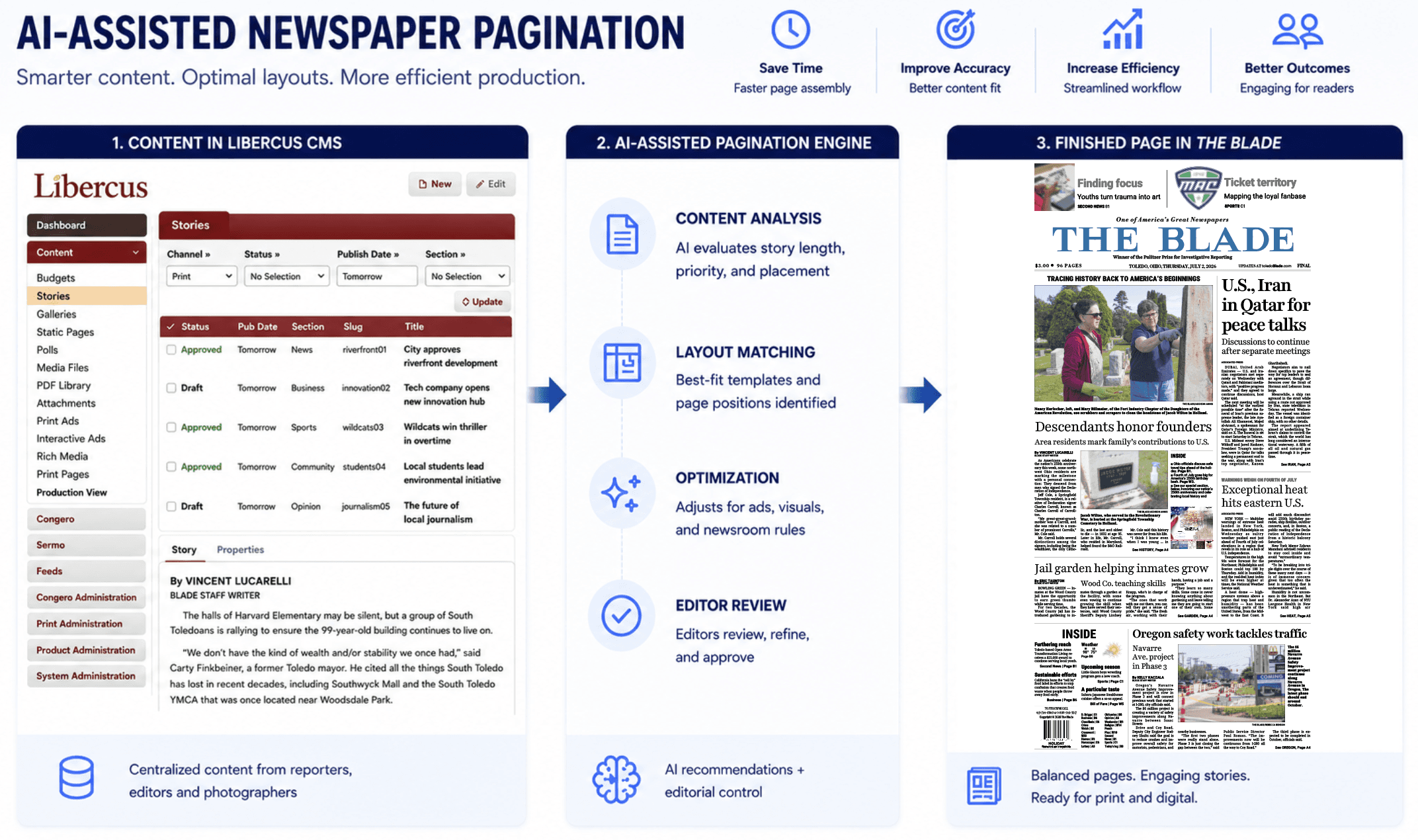
Newspaper production is one of the most time-sensitive editorial workflows. Each edition requires copy editors and page designers to review stories, headlines, page layouts, and print requirements while meeting strict deadlines.
At Block Communications, I identified an opportunity to explore how AI-assisted pagination could streamline page production, improve workflow efficiency, and preserve editorial oversight over final publishing decisions.
The initiative required close collaboration across editorial, engineering, product, and executive stakeholders to evaluate technical feasibility, workflow impacts, and organizational readiness while maintaining confidence in the editorial process.

Key Challenges
Manual, time-intensive page assembly
Tight print deadlines
Story fit, headline sizing, and layout optimization
Balancing automation with editorial control
Coordinating complex cross-functional workflows
The resulting roadmap provided a framework for evaluating AI capabilities, sequencing potential investments, and aligning discussions across engineering, editorial leadership, and platform partners as the organization explored opportunities to modernize print production.
At Block Communications, I identified an opportunity to explore how AI-assisted pagination could streamline page production, improve workflow efficiency, and preserve editorial oversight over final publishing decisions.

The proposed workflow was designed to introduce AI as a decision-support tool within the existing editorial process. Rather than replacing editors, the strategy focused on surfacing recommendations that streamlined page production while preserving editorial control over final publishing decisions.
The design emphasized seamless integration with existing newsroom tools so editors could review, refine, and approve AI-assisted recommendations within their established workflow.

Key design considerations included:
Existing editorial workflows
Story fit and page geometry
Headline sizing and optimization
Print layout constraints
Editorial review and override
Every recommendation was designed to support — not replace — the expertise and editorial judgment of experienced editors.
The proposed solution envisioned an AI-assisted workflow that could evaluate incoming stories, recommend page templates, suggest story placement based on available space, and surface editorial guidance before final approval.
Rather than replacing editorial decision-making, the concept focused on using AI to assist editors with repetitive production tasks while preserving human judgment over page design and publishing decisions.

The initiative produced a strategic framework for evaluating how AI could be introduced into newspaper production while preserving editorial quality and control. Rather than focusing on a single feature, the proposal established a long-term product vision and implementation roadmap for modernizing print production workflows.

Expected Business Value
Streamline page-production workflows
Improve consistency across page layouts
Reduce repetitive editorial production tasks
Preserve editorial oversight through AI-assisted recommendations
Establish a scalable foundation for future workflow automation
Support future AI-enabled publishing capabilities
While the organization ultimately began evaluating next-generation publishing platforms, this initiative demonstrated my ability to identify complex operational challenges, define a long-term product vision, align stakeholders, and create an actionable strategy for AI-enabled workflow transformation.
As Director of Digital, Publishing Division, I led the product strategy and discovery effort for this initiative, partnering across the organization to define the product vision, evaluate AI opportunities, and establish a roadmap for future implementation.
My Contributions
Defined the AI product vision and strategy
Conducted stakeholder discovery and workflow analysis
Developed and prioritized the product roadmap
Authored product requirements and strategic recommendations
Partnered with engineering teams and platform vendors
Presented strategy and recommendations to executive leadership
Cross-Functional Partners
Editorial Leadership
Production Operations
Engineering
Platform Vendors
Executive Leadership
This initiative reflects my approach to product strategy: begin with deep customer and workflow discovery, validate opportunities with stakeholders, and use AI where it augments human expertise rather than replacing it. By aligning business goals, technical feasibility, and user needs, I create product strategies that are both practical and scalable.